By Sherry Wood
“The Red Light District: Vice in Portsmouth, NH, at the Turn of the 20th Century,” opens July 10 in the Randall Gallery. It will bring a fresh perspective to Portsmouth’s houses of ill repute, which flourished after the Spanish-American War of 1898 brought thousands of sailors to the Seacoast.
Research Librarian Jessica Zaricki is curating the exhibit, which covers the years 1897 to 1912, when a new city administration intent on reform shut down brothels. Many of the establishments were on Water Street (now Marcy Street), and several were owned and run by women.
“I really want to make sure I’m focusing on the stories about these people, and they are presented as full human beings, not cartoon characters,” Zaricki said.
One of her primary sources is in the Athenaeum archives — a 1996 UNH honors thesis written by Kimberly Crisp Milani, whose great-great aunt, Alta Roberts, operated a saloon and bordello in Portsmouth.
In a 2005 interview with Foster’s Daily Democrat, Milani described listening to the stories her great aunt Alta Hayward Trefethen told about her great aunt, Alta Warren Roberts, “whose Water Street bordello was purportedly the finest house on the seaboard, with the most beautiful girls.”
“I started with my family experiences and my grandparents growing up in Puddle Dock,” Milani said. “My grandmother and other family members referred me to friends for oral history interviews.”
Other sources are newspaper archives, city directories, U.S. Census records, and Portsmouth City Council and Police Commission meeting minutes, as well as the Portsmouth Navy Yard’s Log Books of Daily Activities.
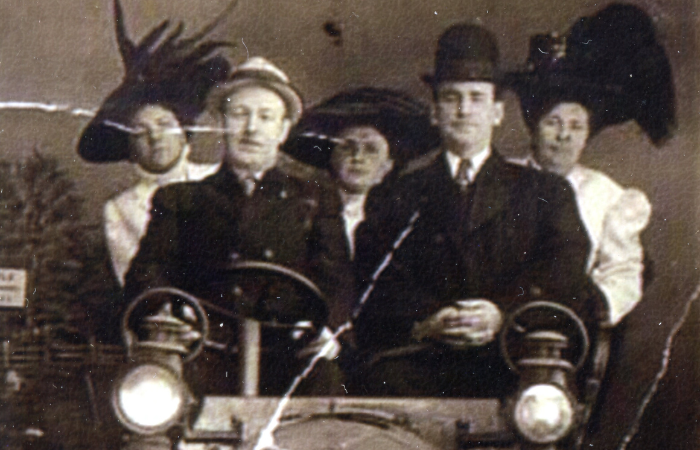
Zaricki is including some of Milani’s family photos in the exhibit, as well as images of several houses of prostitution and items from Charles E. Grey’s Four Tree Island Museum and Emporium, opened in 1877.
“You could get into all sorts of trouble out there — drinking, women, cockfighting. It was said patrons were charged 50 cents for the boat ride to the island and $5 for the return trip,” Zaricki said.
The place burned to the ground in 1902.
Mary Baker owned the Gloucester House on Water Street, where the ferry came over from the shipyard. “The front business, was a saloon and dance hall — upstairs there were less legal things going on,” Zaricki said.
Baker was known for the diamonds embedded in her front teeth, her flamboyant dresses, and elaborate hats and hairstyles.
She and her husband, Allen Baker, owned the property together. The building also had an ice cream parlor.
“Allen put it in because he really didn’t like being a brothel owner,” Zaricki said. “Kids in the Puddle Dock neighborhood would flock there when Allen was at the counter, because he would give large scoops of ice cream, unlike Mary.”
The exhibit will run through Nov. 14 and is open Tuesdays to Saturdays, 1-4 p.m. in the Randall Gallery.
Anyone interested in volunteering to be a gallery greeter can contact Outreach and Volunteer Coordinator Mikayla Tilden at mtilden@portsmouthathenaeum.org.
Exhibit At A Glance
OPENING RECEPTION
Friday, July 10, 2026
5 – 8 p.m.
Randall Gallery, Third Floor, Portsmouth Athenaeum
EXHIBIT CLOSES
Saturday, November 14, 2026
CREDIT: In this circa-1900 family photo provided by Kimberly Crisp Milani, Portsmouth bordello owner Alta Warren Roberts, (back seat, right) is seated with her nieces, Leona Hayward (middle), and Ida McGinnis, (left). At the steering wheel is Ida’s husband, Bill McGinnis. The man in the bowler hat is unidentified.